If you’ve ever looked at a greyhound race card and felt like you were reading a different language, you’re in good company. There’s a lot packed into a small grid — numbers, letters, abbreviations — and most betting apps don’t bother explaining any of it.
This guide breaks it all down. By the end, you’ll know exactly what every column means and what to actually look for before you place a bet.
What Is a Greyhound Race Card?
A race card is the information sheet for a greyhound race. It lists all six dogs running, their trap draw, recent form, best times, trainer, and other details that help you assess each dog’s chances.
In the UK, race cards are available on betting apps like Bet365, Ladbrokes, and SkyBet, as well as on the GBGB (Greyhound Board of Great Britain) website and dedicated greyhound sites like Greyhound-data.com.
The Trap Draw
Every greyhound race uses a starting trap numbered 1 to 6. Trap 1 is on the inside rail, trap 6 is on the outside.
This matters more than casual punters realise. Some dogs are natural “railers” — they hug the inside bend and perform best from low traps. Others are “wide runners” who need room to find their stride and suit higher traps. A railer drawn in trap 5 is at a disadvantage before the race even starts.
When you’re reading a race card, note the trap number and ask whether this dog suits that position based on its recent runs.
The Form Figures
The form string is the row of numbers and letters next to each dog’s name — something like 2-1-3-1-4-2. Each figure represents a finishing position in a recent race, with the most recent run on the right.
Here’s what the common symbols mean:
1–6 — finishing position in that race
0 — finished outside the top six (rare in a six-dog race, usually means a fall or disqualification)
F — fell during the race
U — unseated / brought down
W — withdrawn before the race
D — disqualified after the race
– — separates runs at different tracks or over a period of time
A dog with a form string of 1-1-2-1-1 is clearly in excellent recent form. A string of 5-4-6-5-4 suggests a dog that’s been running but not troubling the winner. Context matters — what grade were those races? What was the competition like?
The Grade
UK greyhound races are graded from A1 (the fastest, most competitive) down to A9 or lower, with OR (open race) at the top and S grades for sprints. A dog stepping up from A6 to A4 is facing significantly stronger competition. A dog dropping down from A3 to A5 may well be too good for this field.
Grade movement is one of the most underused pieces of information on a race card. If a dog has been running well at A5 and has been dropped to A6 or A7, that’s a very different proposition to a dog arriving at the same grade after a string of poor results.
Best Recorded Time (BRT)
The BRT is the fastest time a dog has recorded at that track and distance. It’s expressed in seconds — for example, 28.74 at 480m.
The BRT tells you the dog’s ceiling — its best possible performance under ideal conditions. Compare BRTs across the six dogs in the race and you get a rough picture of which dogs have the raw pace to win if everything goes right.
Bear in mind that BRTs are set under different conditions on different days. A BRT set on fast going in summer is not directly comparable to a run on heavy ground in November.
The Trainer and Kennel Form
On most UK race cards you’ll see the trainer’s name alongside each dog. Experienced punters pay attention to trainer patterns — certain kennels have strong records at specific tracks, or with dogs returning from breaks, or with juveniles.
This is harder to assess without historical data, but it’s worth noting if a trainer has recently had a good run of form, or if they’re known for running dogs fit off a break.
What to Look For in 60 Seconds
Once you understand the basics, a quick pre-race read looks something like this:
. Trap draw — does each dog suit its trap based on running style?
. Recent form — who’s been finishing first or second consistently?
. Grade movement — is anyone dropping in class or facing a step up?
. BRT — who has the raw pace in this field?
. Last run — when did each dog last race? A dog returning after three weeks may need the run.
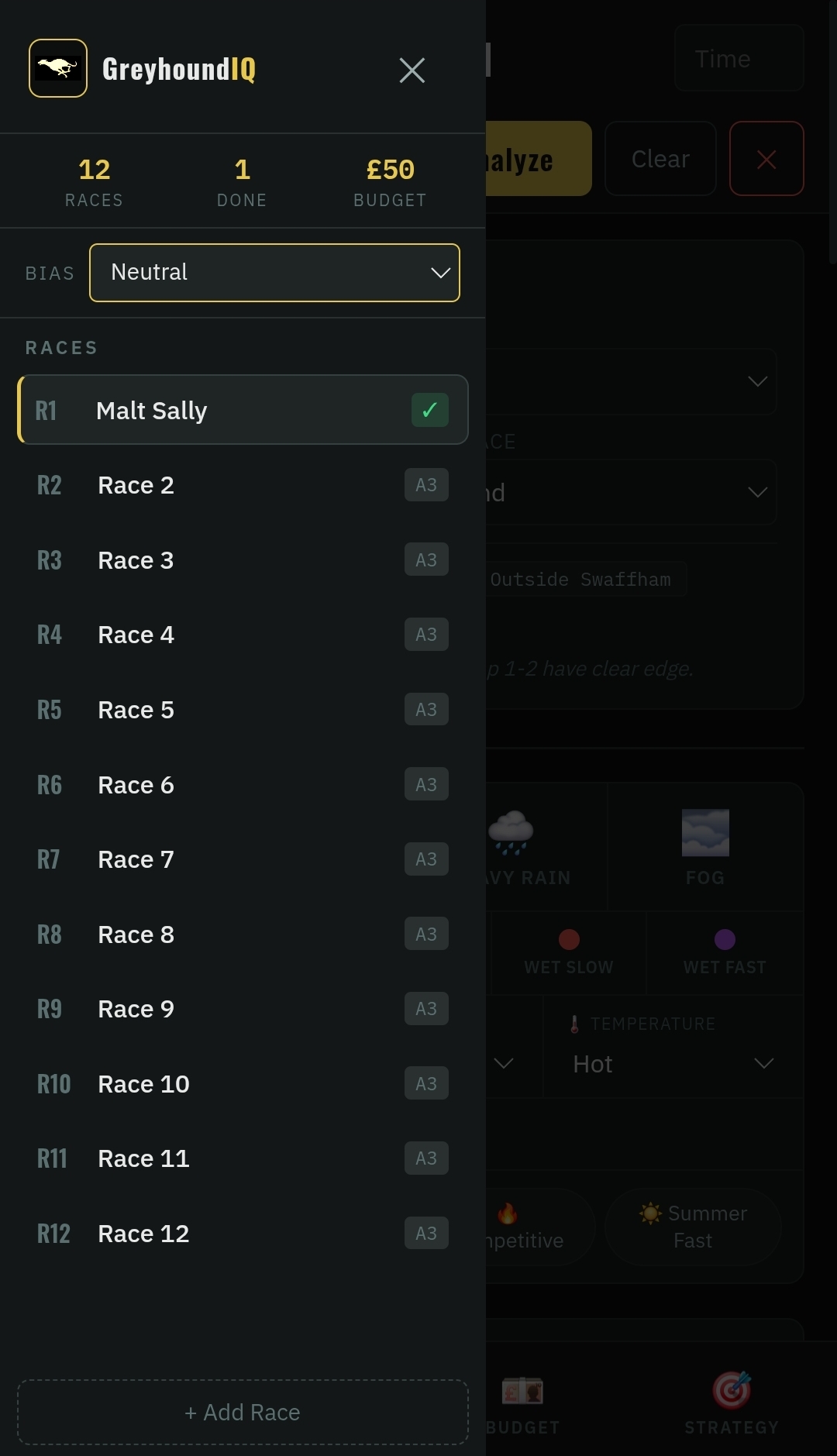
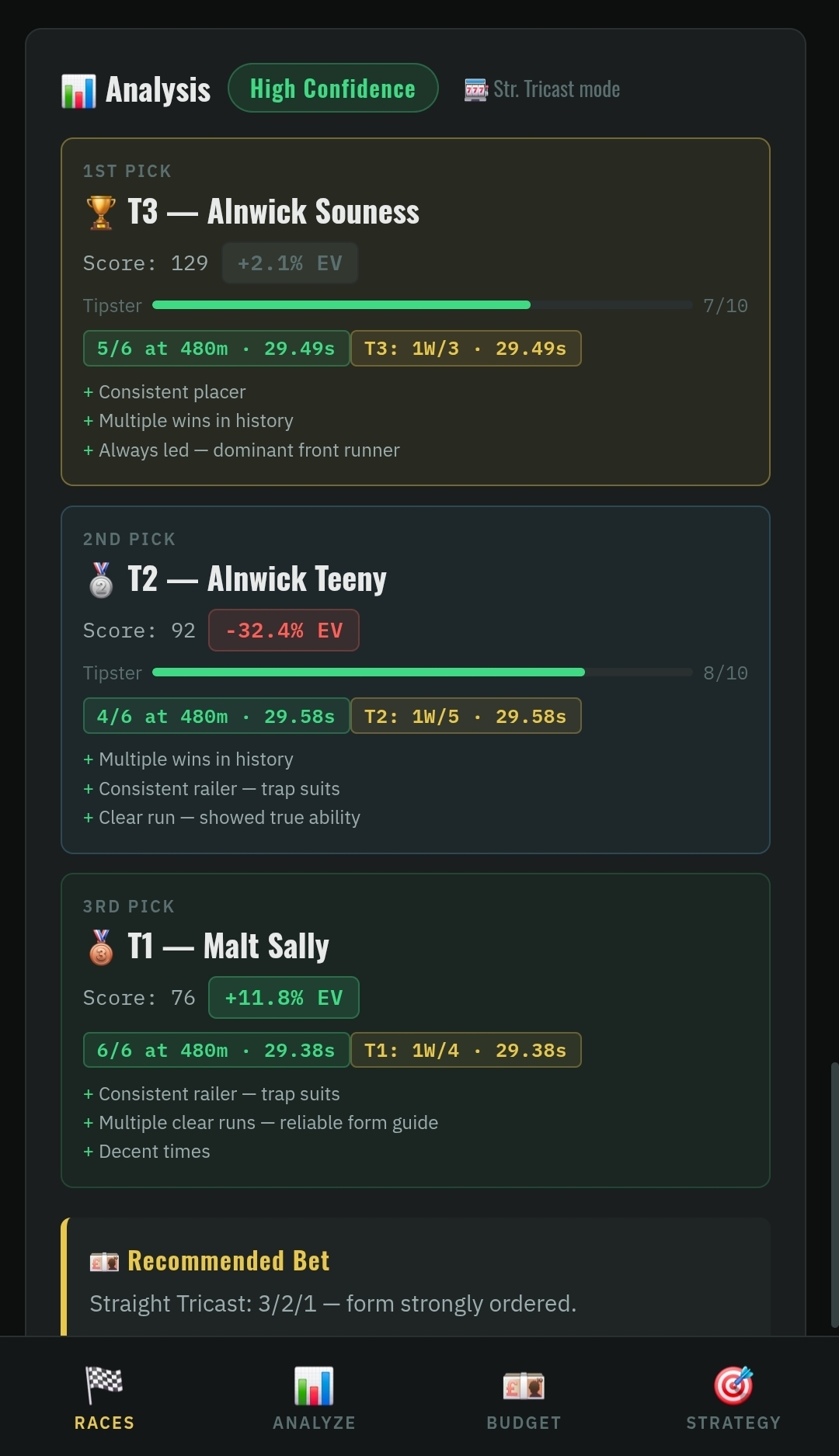
This is exactly the process that GreyhoundIQ automates. Scan the race card with the app and it reads all of the above automatically, scores each dog, and flags where the value lies — saving you the manual work on every single race.
The Bottom Line
Reading a greyhound race card isn’t complicated once you know what each column means. The form figures, the trap draw, the grade, and the BRT give you the core picture. Everything else — conditions, drift, tipster consensus — adds layers on top.
The punters who do this consistently, race after race, are the ones who make more informed decisions over time. That’s not a guarantee of profit. But it’s a far better starting point than backing a name you like the sound of.
About Greyhound_IQ
Use a dynamic headline element to output the post author description. You can also use a dynamic image element to output the author's avatar on the right.