The UK has over 20 licensed greyhound tracks, and each one has its own personality. The bends, the camber, the surface, the typical grades — they all vary, and they all affect how form translates from one venue to another. A dog that tears around Monmore won’t necessarily handle Wimbledon the same way.
This guide covers the major UK tracks, what makes each one distinctive, and what to look for when assessing form.
Monmore Green (Wolverhampton)
Monmore Green — is one of the most active BAGS tracks in the country, hosting up to three meetings a day. It’s a 462m circuit with a fairly tight first bend, which favours early-pace dogs from low traps.
What to look for at Monmore:
. Trap 1 and trap 2 have a strong record at the shorter distances due to the sharp first turn
. Dogs with fast early sectionals perform well here — it’s hard to make up ground from the back on the shorter trips
. The A3–A5 grade range is heavily contested, so form in these grades is competitive and transfers reasonably well between meetings
Monmore is one of the best-understood tracks for form analysis because of the sheer volume of racing that takes place there. With three meetings daily, patterns emerge quickly.
Romford
Romford (Coral Stadium) is a 460m left-handed track in East London with a strong punting culture — it generates some of the highest betting turnover of any UK greyhound venue.
What to look for at Romford:
Wide runners and middle-to-wide draws have a historically strong record here due to the track’s generous camber on the bends
The going at Romford can vary significantly across meetings — always check the going report
Romford is a strong BAGS venue, so form here is widely respected when dogs travel to other tracks
Wimbledon
Wimbledon is the closest thing British greyhound racing has to a prestige venue, hosting major open race events including the English Greyhound Derby final. It’s a 480m circuit, left-handed, with wide, sweeping bends.
What to look for at Wimbledon:
The bends suit wide runners more than many other UK tracks — dogs that suit trap 4, 5, or 6 often over-perform relative to their form at tighter tracks
Open race form here is among the most reliable in the country for assessing elite greyhounds
The track plays faster in dry summer conditions — going is a significant variable at Wimbledon
Nottingham (Colwick Park)
Nottingham is a 450m track with a reputation for producing fast times. It’s a popular BAGS venue and generates a good volume of daily racing.
What to look for at Nottingham:
Fast-surface conditions at Nottingham can produce BRTs that look exceptional on paper but don’t always replicate at slower tracks
Trap 1 has a slightly stronger-than-average record here due to the track’s configuration — rail runners do well
Dogs returning from a short break often run well here — trainer patterns are worth noting
Sheffield (Owlerton)
Sheffield is one of the larger tracks in the UK at 500m, making it one of the longer standard distances. The extra yardage suits strong, stamina-based runners over early-pace specialists.
What to look for at Sheffield:
Form at shorter distances (460–480m) doesn’t always translate — dogs need the stamina to sustain their run over 500m
Sheffield’s strong following and regular evening meetings produce consistent grading that makes form relatively reliable within the track
It’s worth checking how a dog has previously performed at 500m specifically, not just at Sheffield
Perry Barr (Birmingham)
Perry Barr is a 460m track in Birmingham with a tight, enclosed feel. It’s a busy BAGS venue and one of the key tracks in the Midlands alongside Monmore Green.
What to look for at Perry Barr:
. The tight bends at Perry Barr tend to suit railers and early pacers — wide runners can find it harder here than at more open circuits
. Dogs that have run well at Monmore often transfer well to Perry Barr given the similar tight-bend nature of both tracks
. Evening meetings at Perry Barr attract sharper punting — the market tends to be more efficient than at quieter daytime meetings
How Track Knowledge Improves Your Betting
Understanding track characteristics helps in two ways.
First, it helps you assess whether a dog’s form is genuinely applicable to today’s race. A dog with a string of strong runs at a wide, sweeping track may struggle at a tight, short-bend venue, even if the grades match up.
Second, it helps you spot value in the market. Occasional punters who aren’t track-aware will often price a dog based on its recent form string alone, without factoring in whether it suits the course. If you know that a railer tends to struggle from trap 5 at this specific track, and the market hasn’t fully adjusted for it, that’s an edge.
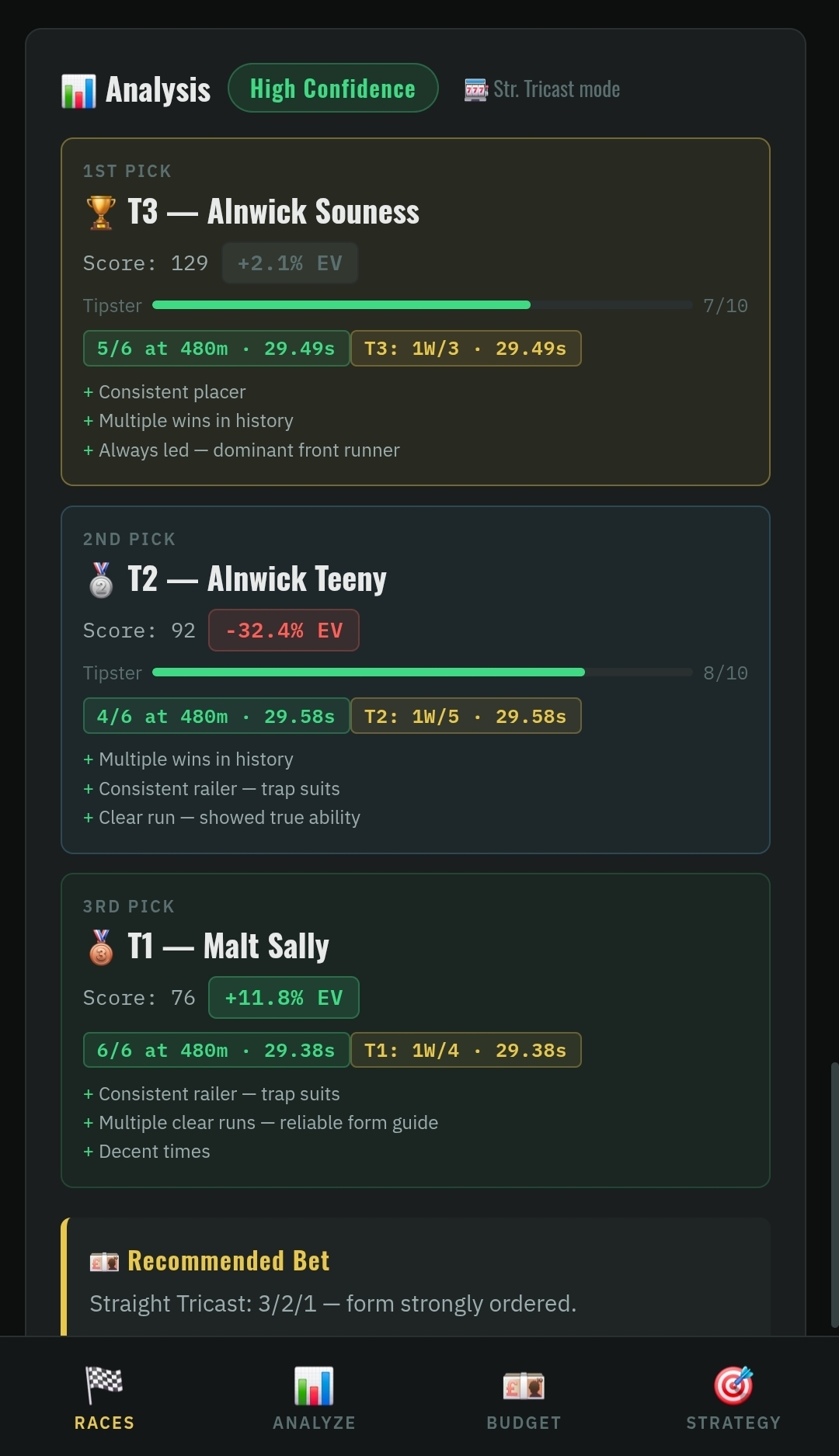
GreyhoundIQ’s track & conditions engine accounts for these biases automatically — adjusting each dog’s confidence score based on how their running style and recent form maps to the specific track and conditions of today’s race. It’s the kind of analysis that takes an experienced form student years to build up manually.
The Bottom Line
There is no single “best” greyhound track for betting. Each venue has its own characteristics and its own betting market dynamics. The punters who do best over time are the ones who understand those characteristics and factor them into their assessment — not just the form figures in isolation.
Whether you’re betting on Monmore, Romford, Sheffield, or anywhere else, the principle is the same: understand the track, understand the conditions, and let the form speak in that context.
About Greyhound_IQ
Use a dynamic headline element to output the post author description. You can also use a dynamic image element to output the author's avatar on the right.